

Foundation models for human motion: understand the tech transforming 3D industries.
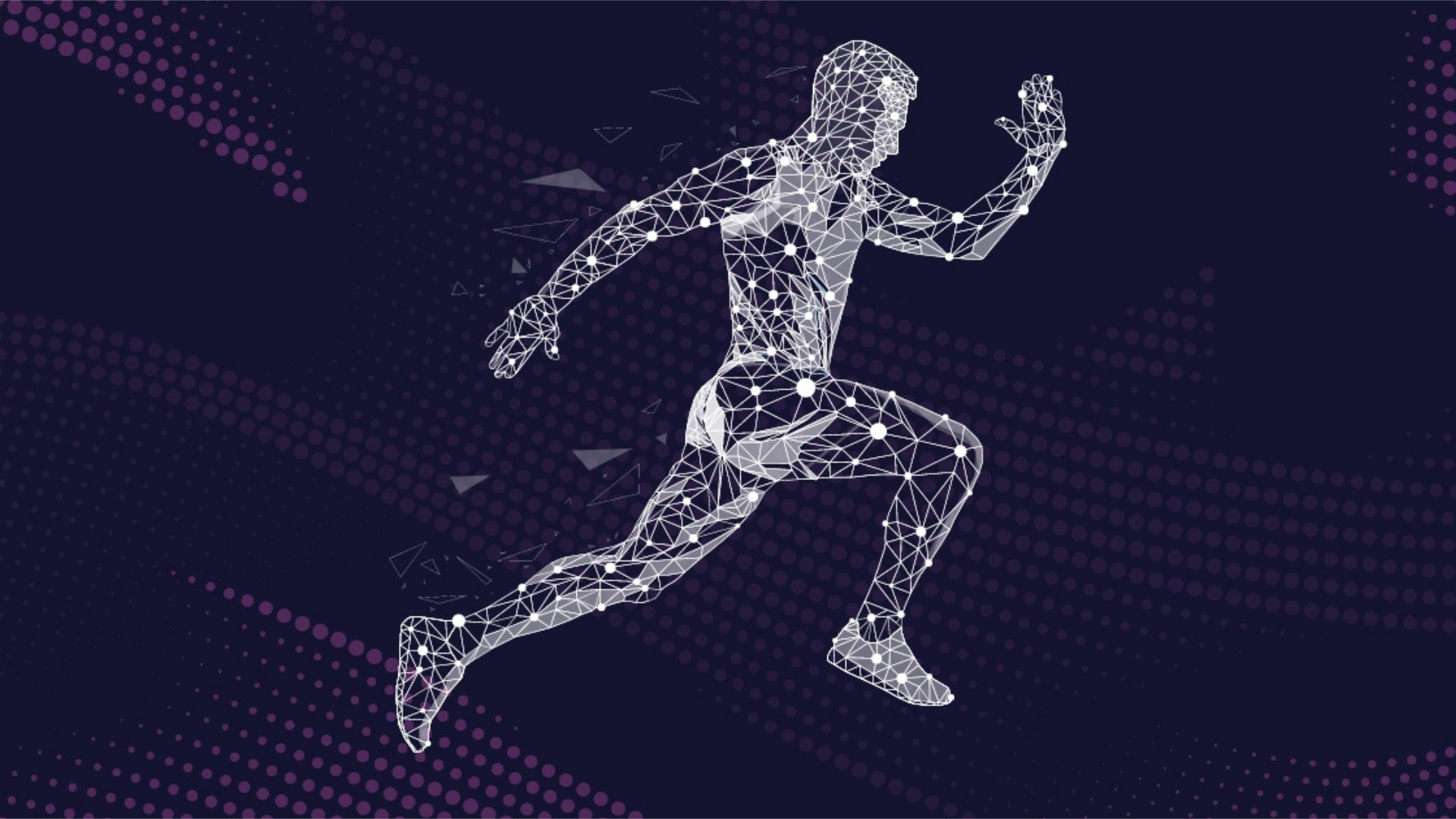
Foundation models for human motion represent a significant shift in how the industry understands and generates motion data. These large AI systems learn from extensive motion datasets to create flexible models that can power everything from animation studios to robotics.
Foundation models are large-scale AI systems trained on diverse movement data. They capture the patterns, physics, and nuances of how humans move across different activities, environments, and body types.
Unlike traditional motion capture systems that record specific movements, these models learn the underlying structure of human movement. They can generate new movements, predict motion sequences, and adapt to different scenarios without requiring extensive retraining.
These models are trained on motion data from sources like motion capture studios and video footage. The AI learns relationships between joint positions, timing, and movement dynamics.
The training process involves analyzing large volumes of movement data. A model learns to predict what comes next in a motion sequence, understand spatial relationships between body parts, and recognize movement patterns across different activities.
Animation and Gaming: Studios use motion models to generate realistic character movement faster than traditional methods. Animators can describe what they want—or provide a reference video—and get naturalistic, editable motion.
Robotics: Structured human motion gives humanoid robots demonstrations and motion references for learning human-like movement in human environments.
Simulation: Populating virtual environments and 3D worlds with varied, controllable human movement for gaming, training, and evaluation.
Data quality remains a primary concern for the industry. Uthana approaches it from two directions: a studio-captured, human-reviewed motion dataset prepared for AI training and evaluation, and video-to-motion models that extract structured 3D movement from ordinary video—extending coverage beyond what any capture stage can record.
Iteration speed matters as much as scale. Uthana's models generate motion from a text prompt or a video clip, let you preview the result in the browser, and export editable animation into standard 3D formats—so teams can evaluate motion in their own pipelines rather than trusting a rendered preview.
Generalizing across different bodies is an ongoing challenge for the whole field. Rather than claiming one model fits every body, Uthana addresses embodiment differences directly with retargeting—adapting motion across different bipedal character skeletons, and translating human movement into humanoid robot representations for training and simulation workflows.
The platform is organized around three layers: models that generate human motion from video, text, and control inputs; data prepared for training and evaluating motion systems; and embodiment tools that move motion across characters and robots.
Motion models are changing how teams create, analyze, and understand movement. As these systems become more capable and accessible, they open new possibilities across every industry that depends on accurate, scalable human motion—and Uthana is building the platform layer underneath them.
Start generating motion today, or work with us on a custom dataset, embodiment system, or simulation program.